We ran a side-by-side production demo to find out how much insulated coolers affect early-age strength reporting — and whether Match-Cure curing gives a more accurate picture of in-place concrete.
Background
A precast concrete producer partnered with Sensytec to compare three curing conditions head-to-head during a live production pour: traditional insulated cooler-cured cylinders, SensyCure Match-Cure panel-matched cylinders, and the actual in-situ panel cured ambient under tarp.
The question was simple: Are cooler-cured cylinders actually representative of what's happening in the panel? And if not, by how much are they off?
The Problem with Coolers
Insulated coolers are standard practice across precast. The assumption is that they approximate field curing conditions well enough. But during hydration, the exothermic reaction inside a sealed cooler has nowhere to go. Heat builds up, maturity accumulates faster than it should, and the cylinder ends up curing in conditions that don't match the element it's supposed to represent.
That matters when stripping, stressing, or release decisions are based on those cylinder breaks.
Temperature Results
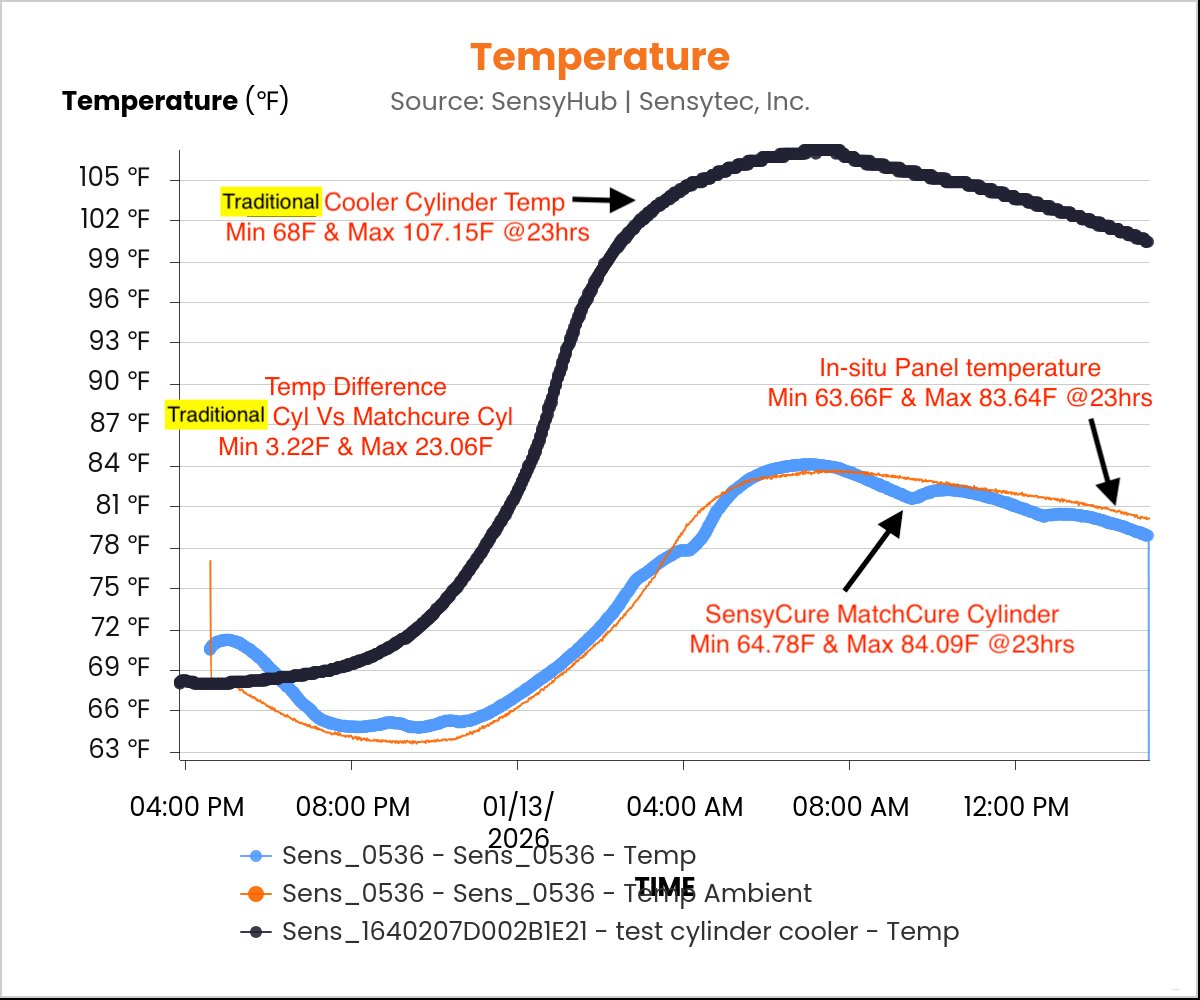
Over the first 23 hours, the temperature gap between methods was significant.
Temperature profiles over the first 23 hours. Source: SensyHub | Sensytec, Inc.
The maximum differential between cooler and Match-Cure exceeded 20°F during early hydration — the period that matters most for maturity calculations.
Strength Results
Higher cooler temperatures meant faster maturity accumulation, which inflated the reported 1-day compressive strength.
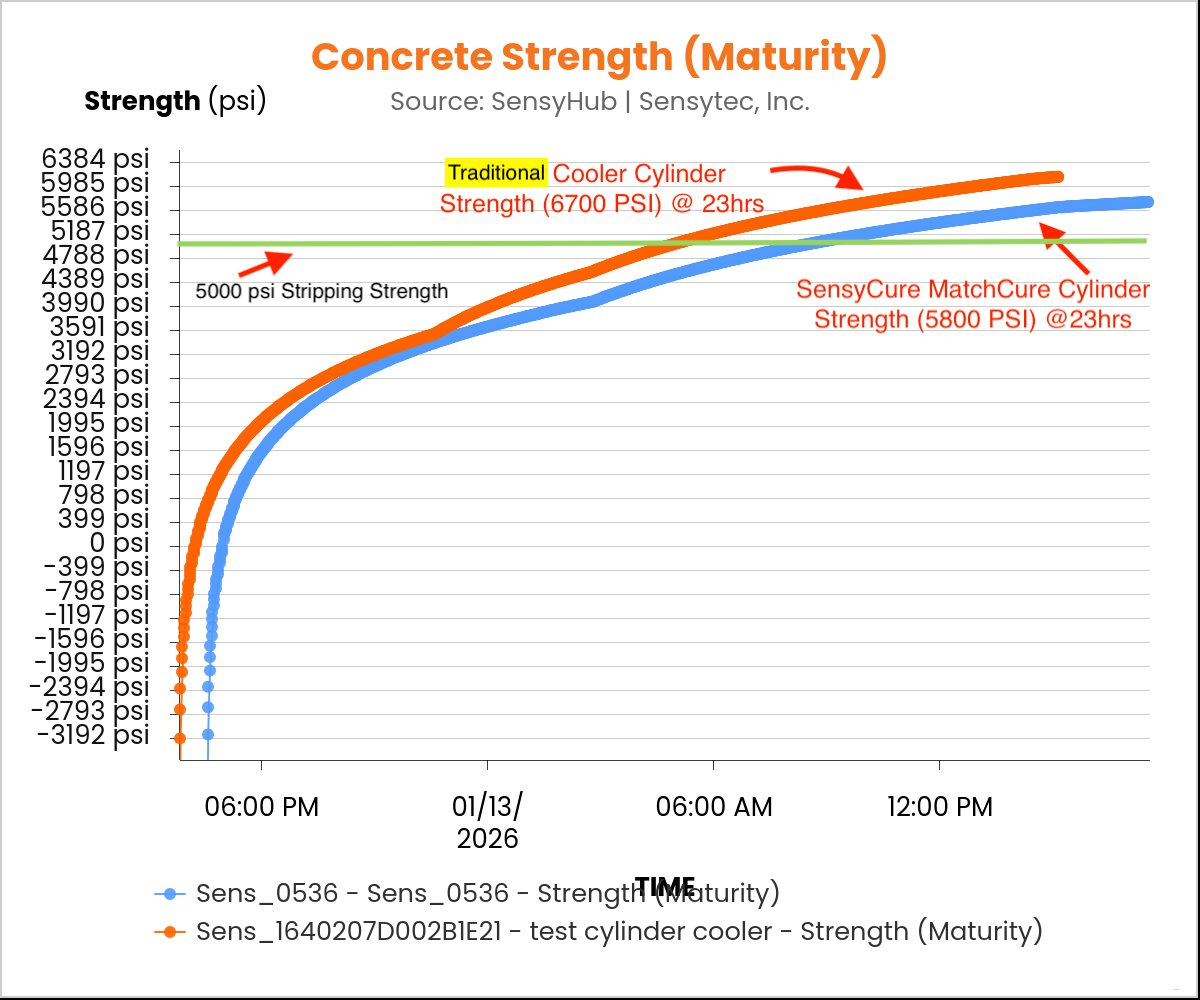
Strength (Maturity) comparison at 23 hours. Source: SensyHub | Sensytec, Inc.
Both sets of cylinders came from the same batch, same mix, same pour. The only variable was the curing environment. The 900 psi gap is not a concrete quality issue — it's a testing artifact.
What This Means
1. Coolers accelerate curing whether you want them to or not.
The sealed insulated environment trapped enough exothermic heat to push cylinder temps more than 20°F past what the panel actually experienced.
2. The strength gap comes from the environment, not the concrete.
Same mix, same pour — 900 psi difference. That's entirely a function of how the cylinders were cured, not what they were made of.
3. Match-Cure tracked the actual panel within ~1°F.
The SensyCure cylinder followed the in-situ thermal profile through the full monitoring window, producing a strength number that actually reflects what's happening in the element.
Bottom Line
If your team is making stripping or release decisions based on cooler-cured cylinder data, you may be working with numbers that overstate actual in-place strength by 15% or more. SensyCure Match-Cure removes that variable — the cylinder cures at the same rate as the element, so the break result means what it should mean.
About SensyCure
SensyCure is Sensytec's automatic match-cure system. It reads the real-time temperature profile of the in-place concrete and replicates it inside a controlled curing chamber, so test cylinders develop strength at the same rate as the actual structural element. The result is ASTM-compliant data that's representative of real conditions — not an insulated box.